
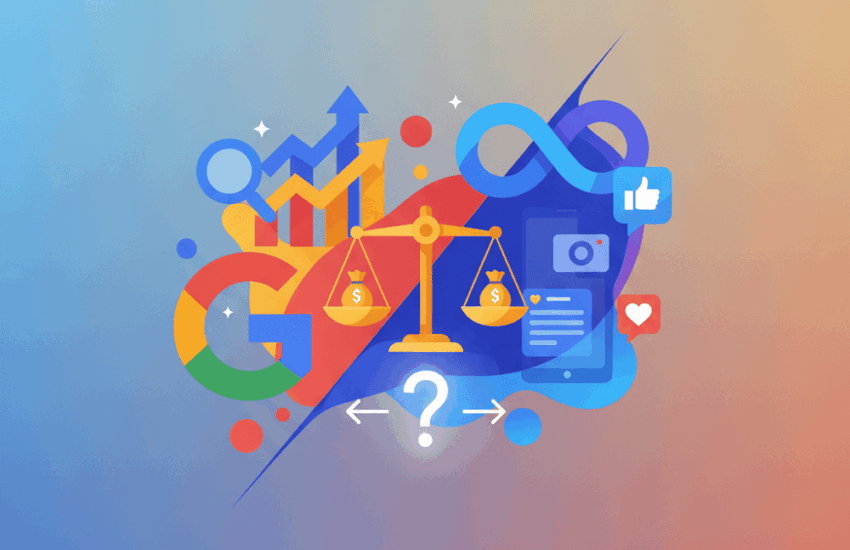
Looking at google ads vs meta ads for 2025? You want clear answers on ROI and a plan that fits your budget. This guide breaks down Pull vs Push, CPC, Conversion Rate, Search Intent, funnel stages (TOFU, MOFU, BOFU), Retargeting, and Attribution. If you run an SMB or lead a marketing team, you will get a clear, practical budget split you can act on this quarter. You will learn when to use each platform, how to estimate costs and outcomes in India, and how to fix attribution so your numbers tell the truth.
The Fundamental Difference: Intent vs Interest in google ads vs meta ads
Think Pull vs Push. Google is a Pull, users come with intent. Meta is Push, you reach people who fit but are not searching yet. Google captures demand. People search on Google, compare on Shopping, and find local options on Maps. If a user types “best dentist in Andheri” or “buy whey protein online,” they are already in-market. You can intercept that intent with Search, Shopping, YouTube, and Maps placements. This is BOFU and MOFU territory, with high conversion quality and tighter volume ceilings. Meta creates demand. You reach audiences based on interests, lookalikes, and behaviors across Facebook, Instagram, and Messenger. You can tell a story, build recall, and nudge impulse buys. Reels and Stories stop the scroll. This is TOFU and MOFU, where frequency, creative, and retargeting do the heavy lifting. Quick decision rule: use Google when people are searching now. Use Meta to build awareness, shape preferences, and spark desire before users ever search. For a broader perspective on cost and ROI patterns, see this practical comparison on Google Ads vs Facebook Ads: cost and ROI in 2025.
Google Ads: Capturing High-Intent Searchers (Pull Strategy)
Users on Google show intent with keywords like “best plumber near me” or “book Bali tour package.” That is why Google is a BOFU workhorse. You win with Search for direct leads and calls, Shopping for in-market buyers, and Maps for local. YouTube and Display help with discovery and remarketing but perform best when paired with solid Search coverage. Best use cases:
- High-intent lead gen with calls and forms
- Shopping for products with clear demand and price comparisons
- Local services where proximity matters
Expect stronger conversion quality but often higher CPC. The trade-off is worth it when you track cost per qualified lead and down-funnel outcomes. For updated CPC and conversion benchmarks, check the 2025 Google Ads benchmarks.
Meta Ads: Building Awareness and Desire (Push Strategy)
Meta finds the right people based on interests, behavior, and lookalikes, then wins them with creative. It is ideal for TOFU reach, visual storytelling, and impulse-friendly products. Retargeting ties it together, moving warm users to action. Formats that punch above their weight:
- Reels and Stories for thumb-stopping video
- Carousels for product variety
- Collection and Advantage+ Catalog for scalable eCommerce
You often see lower CPC and strong CPM for reach. Creative quality drives results. The first two seconds matter. Clear benefits, social proof, and captions for sound-off viewing make a difference. This breakdown on Meta Ads vs Google Ads aligns with these use cases.
When to use each in your funnel
Meta creates interest, Google captures it. Use Meta to introduce your offer to new audiences and educate with video. Retarget on both platforms to move users from curiosity to consideration. Finish with Google Search when buyers are ready. If you are deciding on google ads vs meta ads for a new launch, start with Meta for reach then scale Google for intent.
ROI Battleground: Cost, Conversions, Targeting, and Creative
Plan budgets by cost and likely outcomes. In India, Google often carries higher CPC due to competition in finance, education, real estate, and SaaS. Meta typically offers lower CPC and efficient CPM for reach, especially in Tier 2 and 3 cities. Conversion Rate is usually higher on Google because of intent. Meta wins on cost to reach, speed to scale, and visual persuasion. Your ROI depends on matching platform strengths to funnel stage. Quick patterns you can use:
- CPC: Higher on Google, lower on Meta. Expect Google clicks to be more qualified.
- Conversion Rate: Higher on Google for BOFU keywords, moderate on Meta unless retargeting is strong.
- Targeting power: Google leads on keyword intent plus audience layers. Meta leads on interest graphs and lookalikes.
- Retargeting: Both are strong. Meta often gives cheaper re-engagement impressions.
Creative fit by platform:
- Google: strong headlines, clear offers, relevant extensions, fast pages. For YouTube, simple visuals, one benefit per scene, clear CTA.
- Meta: bold visuals, fast hooks, benefits upfront, social proof. Rotate winners every two to four weeks to avoid fatigue.
If you want a country-specific take, this guide on Google Ads vs Meta Ads in India outlines common trade-offs SMBs face.
CPC, CPM, and Budget Planning in India
In 2025, expect higher Google CPCs in crowded niches like finance, education, and real estate. The upside is strong conversion quality from high Search Intent. Meta often shows lower CPC and efficient CPM, which helps reach and retargeting at scale. Tier 2 and 3 markets tend to be more affordable on Meta, with Reels boosting cost-effective reach. Start with small tests, then shift budget by cost per lead or cost per sale. Use rolling 14-day windows to smooth out noise. Move spend toward the channel that hits target CPA or ROAS with stable volume. For a quick benchmark view on costs and ROI patterns, see this take on which is better for ROI in 2025.
Targeting and Audiences that drive ROI
- Google: keywords plus audience layers. Use In-market, Custom Intent, and remarketing lists to tighten relevance. Protect brand and category keywords with exact and phrase match. Maintain negative lists to improve signal.
- Meta: interest targeting, lookalikes, and detailed demographics. Use broad audiences with strong creative for scale. Refine with retargeting pools from site traffic, video views, and engaged users.
Control overlap between campaigns and watch frequency. Improving audience freshness and creative variety often drops CPA without new spend.
Creative requirements and what converts
- Google: write benefit-led headlines, add site links, callouts, and structured snippets. Align copy to keyword intent. Your landing page should be fast, mobile-first, and clear.
- YouTube and Display: simple visuals, one core benefit, and a direct CTA. Aim for 15 seconds and a tight hook.
- Meta: visuals carry the message. Hook in two seconds, stack benefits, add social proof, and include captions. Test three to five variations and rotate winners every two to four weeks.
Side-by-Side Comparison: A Marketer’s Cheat Sheet
Skim this table when weighing google ads vs meta ads for your next campaign.
| Feature | Google Ads | Meta Ads |
| Customer Intent | High, users are searching now | Lower to mid, users are discovering |
| Average CPC | Higher, strong quality per click | Lower, efficient reach and clicks |
| Best Funnel Stage | BOFU and MOFU | TOFU and MOFU, with retargeting for BOFU |
| Ad Formats | Search, Shopping, YouTube, Display, Maps | Feed, Stories, Reels, Carousel, Collection |
| B2B Suitability | Strong, keyword-driven problem solving | Moderate, best for awareness and remarketing |
| B2C Suitability | Strong for in-market buyers | Strong for lifestyle, D2C, and visual products |
| Targeting Style | Keywords plus audience layers | Interests, lookalikes, behaviors, demographics |
| Retargeting Strength | Strong across Search, Display, YouTube | Strong across Feed, Stories, Reels, and Catalog |
The Strategic Choice: Which Platform Wins Your Budget in 2025?
Pick based on business type and buying journey, then run a hybrid plan to cover full funnel. Fix attribution so you do not count the same sale twice.
- B2B: lead with Google Search and Performance Max, use Meta for thought leadership and retargeting.
- B2C eCommerce: build demand on Meta with video-first creative, catch buyers on Google Shopping and branded Search.
- Local services: capture “near me” searches on Google and build local awareness on Meta.
Use GA4 or a single source of truth for conversions. Keep UTM tags consistent. Review assisted conversions and view-throughs to see the real contribution of each touchpoint. This clear, consistent setup prevents double counting and gives you an honest read on ROI.
B2B and high-ticket leads: Why Google Ads often wins
B2B and high-ticket services benefit from high Search Intent and problem-solving keywords. Run Search and Performance Max with call and lead form extensions. Use tight keyword themes, negatives, and clear value props to raise Conversion Rate. A SaaS company might target “SOC 2 compliance software” and drive demo requests at strong intent. Close the loop with GA4 and CRM feedback so sales quality, not just form fills, guides spend.
E-commerce and lifestyle: Why Meta Ads often wins
Visual-first brands shine on Meta with Reels, Stories, and carousels. Use Dynamic Product Ads, UGC, and limited-time offers to drive action. A D2C apparel brand can build demand with Reels, retarget product viewers, then convert with free shipping or bundle pricing. Combine Meta’s reach with Google Shopping for BOFU to lift total Conversion Rate and stabilize ROAS.
Local businesses: Use both for the fastest ROI
Google wins on “near me” searches and Maps. Meta builds local awareness and community engagement. Use tight radius targeting, lead forms, click-to-call, and message ads. Test dayparting for call-heavy hours. Simple offers work, like free quotes or first-visit discounts. A dental clinic can capture urgent searches on Google and stay top of mind with Meta video testimonials.
Fix attribution and prove ROI across platforms
Both platforms can claim the same conversion due to different windows and touchpoints. Use GA4’s data-driven attribution as your single source of truth. Apply consistent UTM tags across every campaign. Review assisted conversions and view-through impact so you see influence, not just last click. Improve outcomes with fast, conversion-focused landing pages to raise lead quality and drop CPA. For another angle on platform performance claims in 2025, review this practical summary on which is better for ROI. It pairs well with the benchmark view above.
Conclusion
google ads vs meta ads is not either-or. Use Meta to build demand and nurture attention, then use Google to capture ready buyers with high Search Intent. Here is your plan:
1) Test small on both,
2) Track with one source of truth,
3) Tweak weekly based on CPC, Conversion Rate, and ROAS. If you want a clear, no-fluff audit and a roadmap to higher ROI, book a free consultation. Happy to review your accounts and share a step-by-step plan tailored to your goals.
Call us – Digital Marketing Expert
:%20The%20Ultimate%20ROI%20Showdown%20&%20Which%20Platform%20Wins%20Your%20Marketing%20Budget&media=https://jaymehta.co.in/wp-content/uploads/2025/10/Google-Ads-vs.-Meta-Ads.png)